
How to find the right financing for your business in the Foodvalley region
Whether you're launching a startup or want to scale up your business, growth requires capital. But how do you know which form of financing suits your phase? On this page, you'll discover the difference between subsidies and investments, learn what phases there are from pre-seed to Initial Public Offering (IPO), what types of investors are involved, and how to prepare yourself properly.

Various options for funding your startup
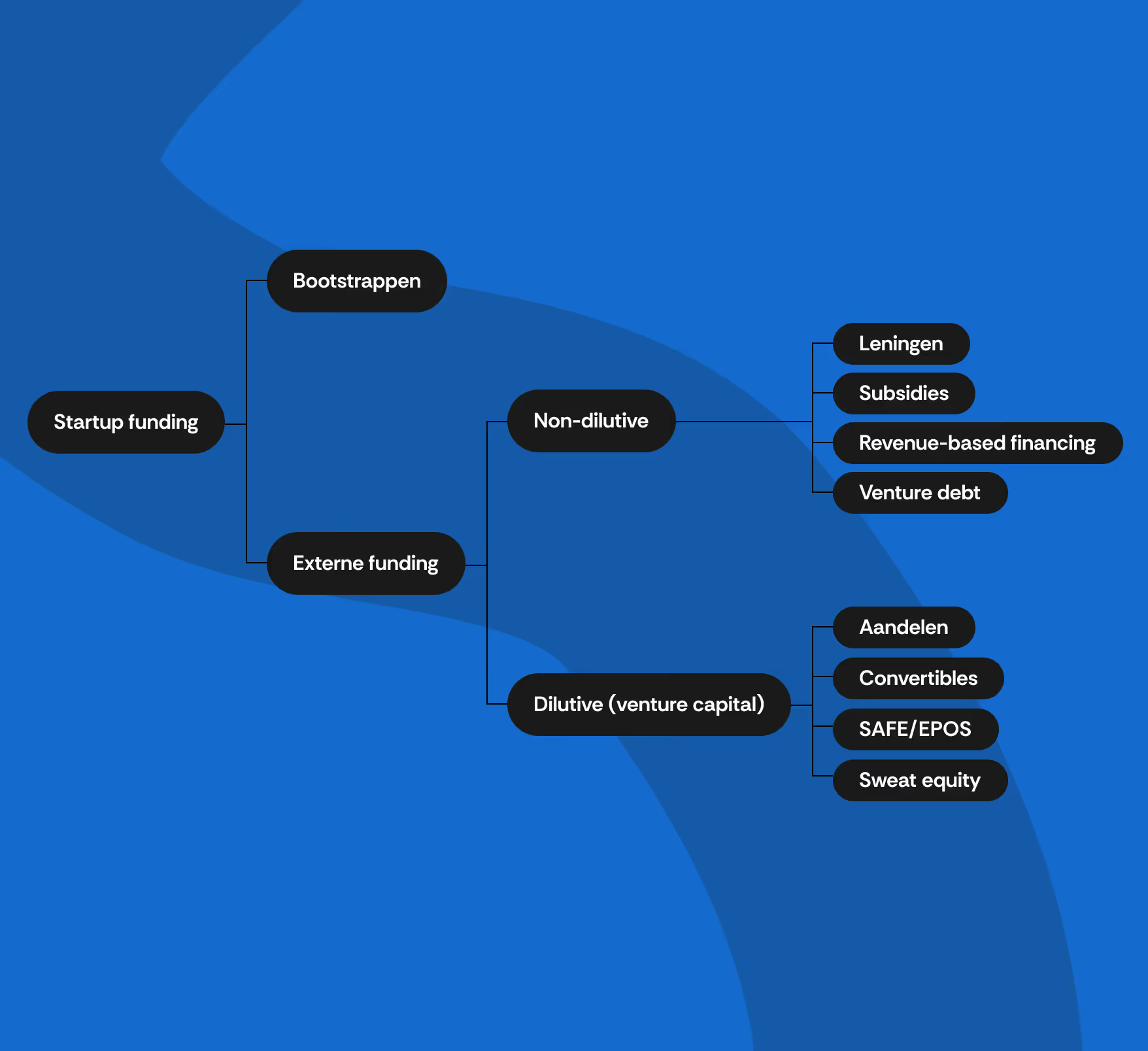
There are various options for financing your startup. In the overview you will find all types of financing, which we will explain below.
Bootstrapping
Investing your own money is called bootstrapping. In Dutch we might say: “eigen broek ophouden” (“standing on your own two feet”). It means keeping your costs low and not distributing any profits, but reinvesting every euro you earn into the growth of your startup. Bootstrapping can be done by putting in your own capital (or founders paying themselves lower management fees) and reinvesting the revenue you generate into growth.
For investors, it is often a positive signal when founders have skin in the game and can sustain themselves from the company’s revenue. It shows something about the team’s commitment and ambition. It is also a way to validate your product–market fit and demonstrate to investors that customers need your product and are willing to pay for it.
The downside is that scaling can be slower because financial resources are more limited. Bootstrapping can feel like a necessary evil, but you can also flip the perspective: scarcity can help you set the right priorities and build a strong foundation for more efficient growth later. And importantly: it creates optionality. If you start looking for investment but don’t get the deal terms you hoped for, you can choose to continue on the bootstrap route. But if you do find the right investor willing to make a fair deal — let’s go.

External funding
If you’ve decided that you want to raise external financing, the next question is: which funding type fits your company? We distinguish between non‑dilutive funding, which does not dilute your equity, and dilutive funding, which requires issuing shares. Below we outline the main forms.
Non-dilutive funding
With non‑dilutive funding you don’t have to give up shares or control. You retain full decision‑making power as a shareholder. There are several types, with loans/innovation credits and grants being the most common.
Leningen
Banks generally do not provide loans to early‑stage startups, because they look for collateral, track record, and repayment certainty — not exactly a startup’s strengths.
An exception is Rabobank, which offers the Rabobank Innovation Loan (RIL) of up to €150,000 for startups contributing to sustainability, digitalisation, or vitality. Regional development agencies such as Oost NL also offer various early‑stage loans, such as the Vroege Fase Financiering.
In Gelderland, the Startupfonds Gelderland provides risk‑bearing loans to young, innovative companies with growth potential — especially tech and agrifood startups that struggle to access traditional financing.
Academic startups, such as WUR spin‑offs, can apply for Take‑off funding: up to €60,000 (phase 1, a grant) or €450,000 (phase 2, a loan) twice per year.
Innovation Credit (RVO)
If you are developing breakthrough technology with market potential, the Dutch government’s Innovation Credit can help. It supports projects with high technical risks as long as the end goal has clear commercial potential.
Grants
There are various grants that give especially technical startups a boost. Impact‑driven startups increasingly have access to grants at local, national, and international levels. Do you want to know more? Check here for availble grants.
Andere opties
Other loan types include venture debt (mainly for later‑stage companies) and revenue‑based finance, where repayments are tied to a percentage of revenue (common for predictable models like SaaS or e‑commerce).
There are also donations, prize money, and crowdfunding. Their relevance depends heavily on your business model. Prize money can be nice — also for visibility — but it’s not something to build your funding strategy on. Crowdfunding can be a loan or a pre‑sale. Some examples
[fs-toc-omit] Donations:
[fs-toc-omit] Crowdfunding
- Invesdor
- Lendahand (focus on upcoming economies)
- Duurzaaminvesteren
[fs-toc-omit] Prize money via competitions
Dilutive funding
With dilutive financing, a startup issues shares, giving the investor a claim on future profits and exit proceeds. The main forms are outlined below.
Equity Investment
An equity investment is the easiest to explain but requires the most paperwork to formalize. Simply put, a person, fund, or company invests money in your business in exchange for shares. As a result, the investor becomes a co-owner of your company and gains decision‑making power. This also means that agreements must be made — not only about the investment itself and the valuation (for example: one million euros for 20% of the shares), but also about the rights and obligations of shareholders. This includes how major decisions are made or who gets paid first in an exit.
Because a lot of paperwork is needed to record these agreements, investors always start with a term sheet. This is a summary of the agreements that will later be included — in much more detail — in the shareholders’ agreement and investment agreement. Ideally, as a founder, you receive multiple term sheets at once so you have options and negotiation power. Once you sign, the lawyers get to work.
Investors often want preferred shares. These come with certain advantages that do not apply to the founders’ common shares. Think of liquidation preferences: the right to receive proceeds from an exit before other shareholders. Make sure you fully understand all deal terms so you don’t sign conditions that aren’t fair. You can read more about this in the book Startup Funding by Sjoerd Mol and Thomas Mensink.
Convertible loan
A convertible loan (CLA or convertible note) is a loan that can be converted into shares. This conversion happens either when the company raises a new equity round or when the loan term (usually two years) ends. At that moment, the loan — plus any accrued interest — is converted into shares. The number of shares the investor receives depends on the valuation of the new round.
Unlike an equity investment, the paperwork for a CLA is usually simple and standardized. On the Capital Waters website, you can download free templates. The four key numbers you need to fill in are:
- The investment amount
- The valuation cap (maximum valuation at which the investor converts)
- The discount (the reduction on the next valuation, usually 20%)
- The interest rate (usually 6–8%)
A CLA often includes both a discount and a cap. At the moment of conversion, the investor may choose which one applies (not both). A smart investor will choose the option that yields the most shares.
The major advantage of a CLA is that it is fast and inexpensive: you don’t need expensive lawyers to draft a shareholders’ agreement, and it doesn’t require a notary. Another advantage is that the valuation discussion is postponed to the next round. Determining the value of a very early‑stage company with little or no revenue is extremely difficult. Still, it’s wise to think carefully about the cap to avoid excessive dilution in the next round.
In theory, the loan could be repaid before conversion, but in practice this almost never happens. Investors don’t invest in risky startups for a bit of interest — they invest for the upside, which only comes with conversion and the potential value increase afterward. They choose a CLA instead of equity mainly because it is more pragmatic for smaller rounds (typically up to around €1 million).
(SAFE) Simple Agreement for Future Equity
A SAFE is somewhat similar to a convertible loan, but it is not a loan. It does not need to be repaid and carries no interest. In essence, it resembles an option: an investor pays money upfront and receives shares in the next equity round — provided such a round occurs.
Like a CLA, a SAFE often includes a cap and a discount. The difference is that a SAFE typically uses only one of the two — either a cap or a discount, usually the cap. Because there is no interest and because only one mechanism applies, the SAFE is more founder‑friendly than the CLA.
The SAFE originated in the United States at the well‑known accelerator Y Combinator and is very popular in (pre‑)seed rounds due to its simplicity. The Dutch equivalent is the EPOS (Easy Prepayment on Shares), although the SAFE is still more commonly used. Some Dutch investors prefer not to use SAFEs and instead choose convertible loans. Whether you choose a SAFE or a CLA depends on the type of investors you want to attract and their preferences.

Types of inverstors
There are different types of investors who can invest in your startup. Below, we highlight the most important groups.
[fs-toc-omit] Friends, Family & Fools
A (convertible) loan or gift from people in your immediate circle can be a quick, accessible, and relatively inexpensive way to obtain startup capital. They know you best and trust you — helpful when your startup is still in an early stage.
But it also carries risk. Your startup may fail, and you don’t want to lose friends over money. They must understand the risk and accept that they may lose the money without damaging the relationship. Always make clear agreements and put them in writing.
[fs-toc-omit] Business Angels
Business angels — or angel investors — play an important role in early‑stage startup financing. These are often wealthy individuals investing their own capital in promising startups.
Besides money, they bring entrepreneurial experience and networks. Many have built and sold their own companies and now invest to support the next generation of entrepreneurs.
Having an experienced or specialized angel on board signals credibility and increases your chances of follow‑on funding. Be cautious with inexperienced angels or those without startup experience — they may micromanage, demand excessive protections, or ask for too many shares.
Finding angels can be challenging. They rarely have websites and are not full‑time investors. LinkedIn sometimes reveals who is active. Use your network to get introductions.
If you want to learn more, take a look at the page on this topic: Find your business angel.
[fs-toc-omit] Venture Capital Funds
Venture capitalists (VCs) are professional investors who invest from a fund. There is no single type of VC — funds vary widely. VCs prefer companies with some revenue and traction. Most have a clear focus (market/technology, stage, geography, business model). Their websites and portfolios reveal this. Instead of contacting VCs randomly, do your homework: which VCs truly fit your company? Those are also the ones most likely to add value.
VCs invest with the expectation that their portfolio companies will grow rapidly and eventually be acquired (the exit). They typically aim for a 10–20x return within 5–7 years. They know not every company will succeed, but winners must compensate for losses. If your company is great but not highly scalable or if you lack the ambition for hyper‑growth, a VC may not be the right match.
Relevant VC funds for Food & Agri startups include (translated list preserved):
- Future Food Fund invests in technological startups that are redefining the future of food and agriculture.
- OostNL invests in innovative companies that contribute to a stronger, more sustainable economy in the eastern Netherlands, with a focus on high‑tech, food, health, and energy.
- 4Impact focuses on tech‑for‑good companies that accelerate the sustainable transition.
- Shaping Impact Group provides growth capital to social enterprises that deliver measurable impact for people and the planet.
- PYMWYMIC is a community of impact investors who direct capital toward positive change.
- Fair Capital Impact Fund invests in startups and scale‑ups with a strong green or social mission, where impact comes first.
- Unknown Group supports entrepreneurs working toward a livable world in 2050.
- Goodwell Investments strengthens companies that make essential products and services accessible to underserved communities.
- Polestar Capital finances projects that enable direct climate action.
- DOEN Participaties supports sustainable and social startups with capital and network access.
- InvestNL finances innovative companies that accelerate major transitions — from climate and circularity to deeptech and agrifood — with an emphasis on scalable impact.
- Invest International focuses on Dutch solutions for global challenges.
- SHIFT Invest invests in impact‑driven startups and scale‑ups accelerating transitions in agri & food, the circular economy, biobased innovation, and climate technology.
- Anterra Capital is an international VC fund financing technology that makes the agrifood chain safer, more sustainable, and more efficient — from farm to fork.
- Astanor Ventures focuses on scalable solutions for a regenerative and fair food system, investing from soil to distribution.
- Aqua‑Spark is a global fund financing sustainable aquaculture and supply chains — from feed and health to farming and technology.
- Rubio invests in startups active in FoodTech, among other sectors. Unique to their model is that their own compensation depends on achieving both financial and impact targets.
Investment stages
A startup moves through several stages, each with its own financing types: Pre‑Seed, Seed, Series A, Series B–E, IPO
[fs-toc-omit] Pre-seed funding
Pre-seed funding typically comes from the founders themselves, Friends, Family & Fools, or early angel investors. There is no strict definition of “pre-seed,” but generally, at this stage you have a minimum viable product (MVP) and a proof of concept, and sometimes a small amount of (pilot) revenue. You can demonstrate problem–solution fit and have an initial sense of the market potential. There is still considerable uncertainty and risk, which you will need to validate step by step. Broadly speaking, these investment rounds go up to €1 million.
[fs-toc-omit] Seed funding
In the seed phase, you can raise funding from angel investors and (small) venture capital funds. Investors want to see customer validation, a working product, and early revenue or strong user engagement. In the Netherlands, seed rounds generally range between €1 million and €5 million. Expect dilution of approximately 15–25%.
[fs-toc-omit] Series A
During a Series A round, you typically raise capital from one or more venture capital investors. At this stage, investors want to see strong traction, growing revenue, and early signs of (international) scalability. Rounds are usually between €5 million and €15 million. Dilution is again around 20%.
[fs-toc-omit] Later stage funding
All stages beyond this (Series B, C, D, and so on — you can go through the entire alphabet) usually involve venture capital funds and are focused on rapid scaling. The goal of these rounds is market expansion, international growth, or preparing for an exit or an initial public offering (IPO).
[fs-toc-omit]Samenvattend
Whether you are scaling fermentation technology, accelerating regenerative agriculture, or building a circular food system — there is generally capital available for entrepreneurs with vision and courage. The key is choosing an investor and a financing instrument that match your company, your growth stage, your impact goals, your vision, and your values.
Other resources for early-stage-startups
In addition to funding, there are incubators and accelerators that can support the growth of your startup. In the Foodvalley Region, several incubators and accelerators offer training facilities, access to financing, and networks of experts. Some also invest directly in startups.
Oost NL also supports startups in finding suitable financing opportunities and provides guidance tailored to the company’s stage. Beyond capital and funding, Oost NL connects startups with knowledge institutions and relevant networks to stimulate growth and innovation.